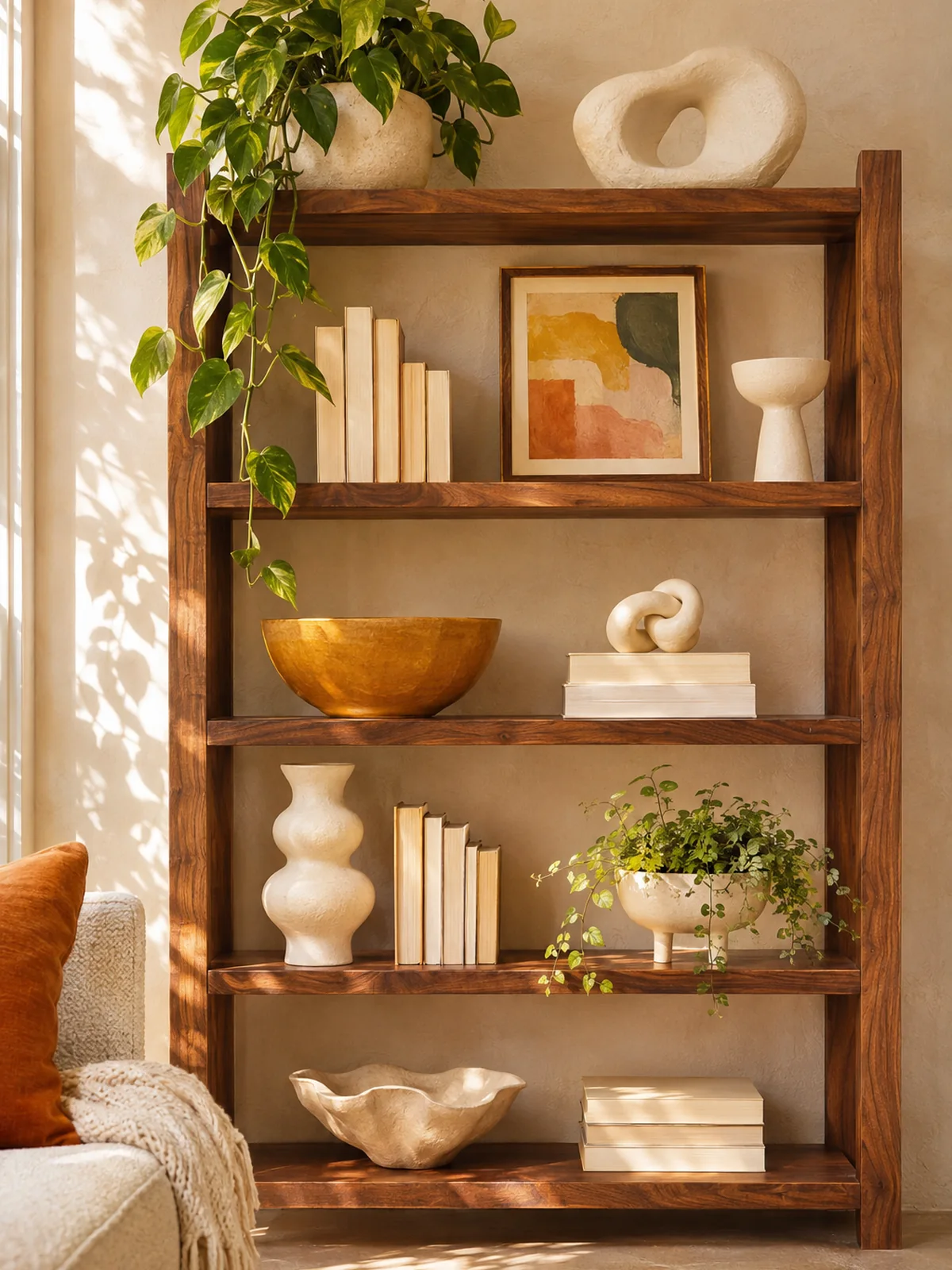
To style bookshelves, organize the books you want to keep, place heavy items low, and arrange a few meaningful objects around the remaining space. Balance visual weight across the unit instead of decorating every shelf the same way, and keep books easy to remove.
This guide may contain affiliate links. As an Amazon Associate we earn from qualifying purchases. How our links work.
What should you do before decorating a bookshelf?
Empty one shelf at a time onto a stable surface rather than piling a whole library on the floor. Dust the shelf and inspect it for bowing, loose fittings, or damaged supports. Check the unit's instructions for shelf load limits. A decorative shelf and a bookcase designed for dense rows of books may have very different capacities.
Sort what came off into books you use, books you want to keep but rarely open, useful storage, and objects that belong elsewhere. This is not a demand to discard sentimental things. It is a way to avoid treating every receipt, cable, and ornament as a permanent part of the display. Return borrowed books and relocate paperwork before designing around them.
Decide what proportion of the unit needs to remain book storage. A reader with a full collection should not be told to remove half their books to achieve an airy photograph. Our home styling guides begin with how a room functions; on a hardworking bookshelf, neat book rows may be the main visual feature rather than something to hide.
How do you make the unit safe before making it attractive?
Follow the bookcase manufacturer's assembly and anchoring instructions. The Consumer Product Safety Commission's Anchor It! guidance addresses furniture tip-over risks, including the importance of securing furniture. Choose fixings suitable for the wall and the unit; a general-purpose adhesive hook is not a substitute for the specified restraint.
Keep heavier items toward the bottom, without treating this as a replacement for anchoring. Avoid placing tempting toys high up where children might climb to reach them. Do not stack furniture on top of the bookcase or place a heavy object above someone's usual seat unless the installation is designed for it. Check that doors and drawers open without destabilizing the unit.
If you rent, ask about approved anchoring methods rather than leaving a tall unit unsecured. Also assess freestanding objects: a large glass vessel near an edge can fall even when the bookcase itself is anchored. In a child's room or an active pet household, a display of lightweight, unbreakable objects may be the more practical choice.
Should books be arranged by color, size, or subject?
Organize for retrieval first. Subject groups work well for cookbooks, art books, and reference material; alphabetical order can help with a larger fiction collection. Color grouping is optional and useful only if you remember books visually. Turning every spine inward may produce a quiet palette, but it makes choosing a title unnecessarily difficult.
Within each category, arrange a reasonably steady height progression rather than alternating the tallest and shortest book repeatedly. You can use a short horizontal stack to bridge an awkward gap, provided it is stable and does not become so high that removing the bottom book is a chore. Keep frequently read titles upright and easy to reach.
Support upright books with neighboring books or bookends that can hold their weight. A lightweight ornamental figurine may not function as a bookend. Avoid cramming books in tightly enough to damage them when you pull one out. The Library of Congress's storage guidance for books is a useful starting point, especially for volumes you want to preserve.
How do you balance a bookcase without making it symmetrical?
Stand back and look at broad shapes rather than individual trinkets. A full row of dark spines carries more visual weight than a small pale bowl. If one side feels crowded, move a medium-sized group to the opposite side or introduce a quieter patch nearby. The goal is an arrangement that feels distributed, not a checkerboard of mandatory decorations.
Try a simple starting arrangement on three adjacent shelves. On the first, use mostly upright books with one supported gap. On the second, place books at one side and a useful box at the other. On the third, run a longer book row. This variation is enough; every shelf does not need a vase, a frame, and a horizontal stack.
Leave some space around objects when your storage needs allow it. If they do not, use consistent book alignment to create order instead. Keep spines at a broadly similar distance from the shelf edge so that the rows read as deliberate. Do not pull books so far forward that they overhang or become unstable.
Which decorative objects earn their place?
Choose a few objects you would keep even if shelf styling were not a project: a small framed photograph, a handmade bowl, or a souvenir with a story. Pick pieces with different silhouettes so they remain distinguishable. Several tiny objects scattered separately usually read as many separate details; grouping a few on a shallow dish can give them a clearer home.
A storage box can do two jobs when it contains an actual category, such as spare chargers or stationery. Label it discreetly if several people need to use it. Measure the shelf depth and the room required to remove a lid or slide out a basket. A beautiful container that cannot open beneath the shelf above is not useful storage.
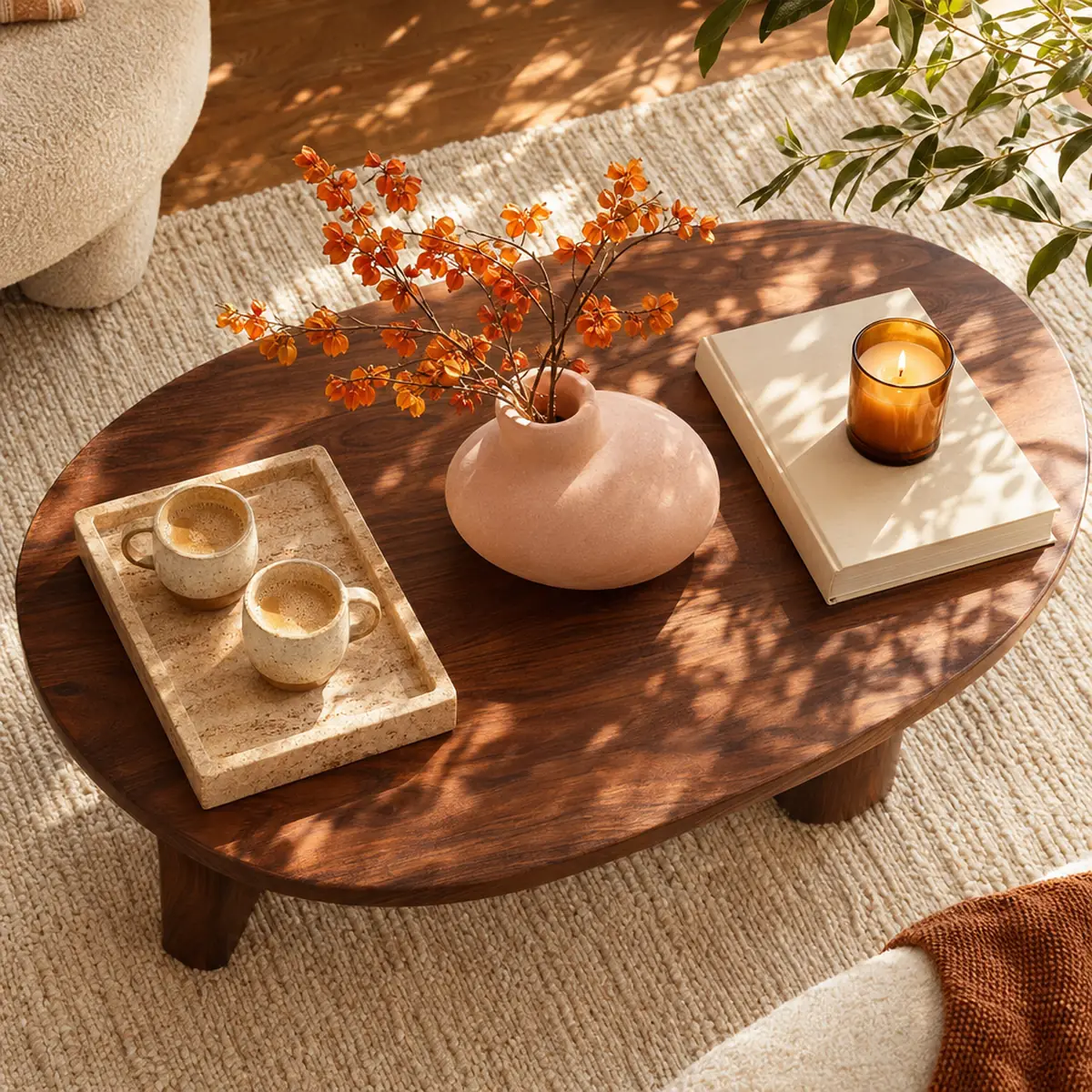
You can carry a room's palette onto the bookcase through just one or two materials, such as warm wood and matte ceramic. There is no need to recolor the whole library. If your shelves share a room with a styled table, coordinate loosely with the approach in how to style a coffee table, rather than duplicating the same objects on both surfaces.
Can plants and lighting go on bookshelves?
Only place a plant where its actual light and care requirements can be met. A deep interior shelf is not automatically a suitable growing spot. Keep watering away from books and electrical fittings, and use a watertight inner container with protection beneath it. Remove the plant to water it if spills would be difficult to catch.
Allow enough room to inspect leaves, lift the pot, and clean behind it. A trailing plant may look attractive, but long stems across a row make retrieving books inconvenient. If plant care does not fit your routine, skip the greenery rather than turning the display into a maintenance problem. Bookshelves do not require a plant to look finished.
For lighting, follow the fixture's installation and clearance instructions and route cords where they cannot be pinched or snagged. Do not place a burning candle in a shelf compartment. Flameless lighting is simpler for a display, but batteries and small components still need to be kept away from young children.
Why do styled shelves sometimes still look messy?
Check for mixed scales and unrelated storage before buying more decor. A tall shelf with only small ornaments can look scattered because each item demands separate attention. Consolidate tiny pieces, give one larger object space, or replace several decorative containers with one practical box. Keep the surrounding floor clear enough that you can comfortably approach the unit.
In a compact room, the problem may be the furniture footprint rather than the arrangement. Our guide to styling a small bedroom explains how to assess circulation before adding storage. A shallow unit may suit a tight spot, but only if its depth accommodates the books and it can be installed safely.
Finish with a retrieval test: take out three books, open every box, and return everything. If you have to dismantle a vignette to reach a favorite paperback, revise that shelf. Photograph the successful arrangement if you like, then let it evolve as books are read. A usable bookshelf is allowed to change.
Your questions, answered
How much empty space should bookshelves have?
There is no required percentage. Leave breathing room where possible, but prioritize safe loads, supported books, and storage you can use. Full shelves can look orderly.
Should every shelf have decorations?
No. Some shelves can hold only books. Varying the length and placement of book groups often creates enough interest without adding objects.
Can I put a bookshelf near a sunny window?
Consider light exposure, moisture, and access to the window. Direct sunlight can damage books; choose a location that protects the collection and keeps the window usable.
Sources & further reading
Sources support the factual guidance they address; aesthetic suggestions are editorial judgment, not claims of product testing.